











The modern warehouse is under siege from every direction. E-commerce order volumes continue to grow at double-digit annual rates. Consumer expectations for same-day and next-day delivery have compressed fulfillment windows from days to hours. Labor markets in logistics remain structurally tight, warehouse worker turnover rates average 46% annually in the United States, and the available labor pool is shrinking as demographic shifts reduce the supply of workers willing to perform physically demanding, repetitive shift work.
The response from forward-thinking logistics operators is not to hire faster. It is to see smarter.
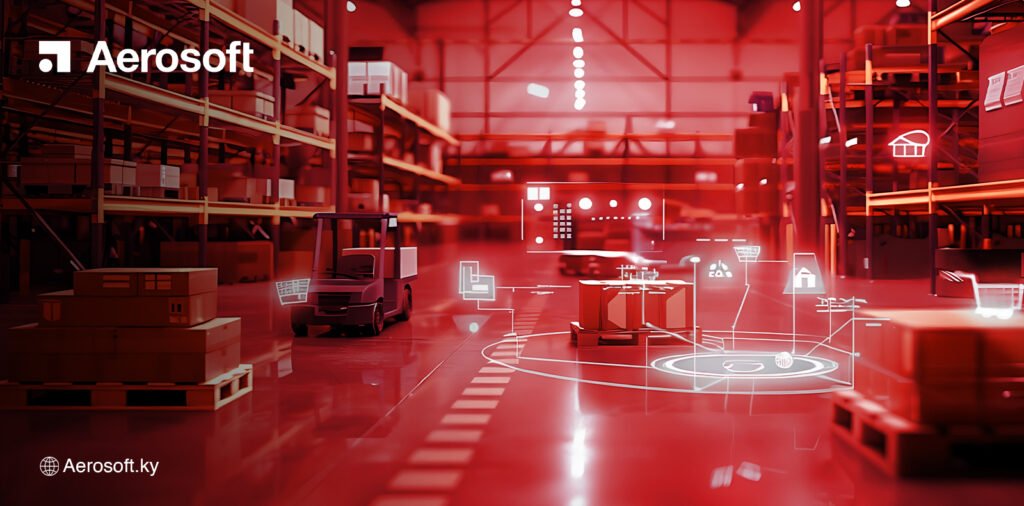
The ‘seeing warehouse’ is not a metaphor. It is a precisely engineered operational environment in which computer vision systems, autonomous mobile robots, and AI-powered orchestration platforms work together to execute fulfillment operations with a level of speed, accuracy, and adaptability that human labor, operating alone, simply cannot match. At AeroSoft Global, we design and deploy these intelligent logistics environments for 3PL providers, e-commerce operators, and enterprise supply chain leaders. This article explains what the seeing warehouse actually looks like, how it works, and what it delivers financially.
Industry Data: Warehouses deploying computer vision and AMR systems report a 40–65% reduction in order fulfillment errors, a 30% improvement in throughput per square foot, and labor cost reductions of 35–50% within 18 months of full deployment.
The Logistics Labor Crisis: Beyond the Headlines
The logistics labor crisis is frequently discussed in terms of wage inflation and worker shortages. These are real pressures, but they are symptoms of a deeper structural problem: the warehouse operating model was designed for a labor market that no longer exists.
Traditional warehouse operations are built around human workers performing discrete, repetitive physical tasks, picking, packing, sorting, scanning, and counting, at scale. This model worked when labor was abundant, affordable, and reliable. In 2026, none of those conditions holds in most major logistics markets.
Average warehouse wages in the United States have increased by 38% since 2020. Turnover costs, including recruiting, onboarding, and training, average $3,500 per worker. A 500-person distribution center with 46% annual turnover is absorbing $800,000 per year just in turnover-related administrative costs, before accounting for the productivity loss during the 4–6 week new hire ramp-up period.
This is the financial reality that is driving logistics operators toward automation, not as a cost-cutting exercise, but as a structural necessity for operational continuity.
Why Partial Automation Has Failed to Solve the Problem
Many distribution centers have deployed first-generation automation: conveyor systems, barcode scanners, warehouse management software, and basic robotic picking arms. These investments improved throughput in specific task categories but left the fundamental labor dependency intact. Workers were still required to handle exceptions, manage inbound receiving, perform quality checks, and adapt to the constant variability of real-world fulfillment operations.
The seeing warehouse solves the exception problem. By giving the warehouse environment the ability to perceive, interpret, and respond to its physical reality in real time, computer vision and AMR systems handle the variability that first-generation automation could not, and they do it at scale, around the clock, without fatigue.
Computer Vision in the Warehouse: What ‘Seeing’ Actually Means
Computer vision in logistics is not simply camera technology. It is a multi-layer AI system that ingests visual data, processes it against trained deep learning models, and generates actionable outputs in milliseconds. Here is what this looks like across the key operational domains of a modern distribution center:
Inbound Receiving and Damage Detection
As pallets and cartons move through the receiving dock, overhead and lateral camera arrays capture multi-angle images of every item. Deep learning models trained on millions of labeled product images identify damaged packaging, incorrect labeling, quantity discrepancies, and product integrity issues in real time, flagging exceptions automatically and routing them to a human decision point before they contaminate the inventory system.
This replaces a manual receiving inspection process that is inherently inconsistent, speed-limited, and subject to fatigue-related errors. More importantly, it creates a timestamped, photographic audit trail for every inbound shipment, invaluable for supplier dispute resolution and insurance claims.
Item Verification and Pick Accuracy
During the pick process, computer vision systems mounted on AMRs or fixed at pick stations verify that the correct item, in the correct SKU, size, color, and quantity, has been selected before it moves to the packing station. This zero-touch quality control layer eliminates the manual scan-and-verify step that currently accounts for a significant portion of warehouse labor cost.
Pick accuracy in manual operations typically ranges from 98.5% to 99.2%. Computer vision verification pushes this above 99.97%, a difference that, at high order volumes, represents thousands of prevented mis-picks per month, each of which would otherwise generate a customer complaint, a return shipment, a replacement order, and a carrier cost.
Inventory Auditing and Cycle Counting
Traditional cycle counting requires dedicated labor to physically walk aisles, scan barcodes, and reconcile discrepancies against the warehouse management system. Computer vision-equipped AMRs perform continuous inventory audits during their normal movement through the facility, capturing shelf-level imagery, comparing it against expected inventory positions, and flagging discrepancies in real time. This eliminates the need for scheduled cycle count labor while producing inventory accuracy levels that manual counting cannot approach.
Key Capability: AeroSoft Global’s computer vision systems identify damaged packaging with 99.4% accuracy across 340+ product categories, including irregular-shaped items, multi-component kits, and high-value electronics that require specialized inspection protocols.
AMR Fleet Orchestration: The Intelligence Layer That Makes Robots Work Together
Autonomous mobile robots are the physical execution layer of the seeing warehouse. But individual AMRs, operating without coordination, create as many problems as they solve, such as traffic congestion, suboptimal pick routes, inefficient charging cycles, and the inability to adapt to real-time demand fluctuations.
AMR fleet orchestration is the AI layer that transforms a collection of individual robots into a coordinated, adaptive fulfillment system. Here is what sophisticated orchestration delivers:
Dynamic Task Assignment and Route Optimization
Orchestration AI continuously monitors order queue depth, pick zone inventory levels, AMR battery status, and facility traffic patterns, assigning tasks and routes in real time to maximize throughput while minimizing congestion and charging downtime. When a new rush order arrives or a pick zone runs low on inventory, the system rebalances robot assignments within seconds, without human intervention.
Real-Time Resiliency: Adapting to Disruption Instantly
The true test of an AMR orchestration system is not how it performs under normal conditions. It is how it responds when conditions change: a carrier pickup is moved forward by three hours, a high-priority order floods the queue unexpectedly, or a pick zone becomes temporarily inaccessible due to a spill or equipment issue.
Advanced orchestration platforms process these disruptions as inputs and respond with real-time task reallocation, priority queue restructuring, and route replanning, all within a decision cycle measured in milliseconds. The human operations manager receives a notification and a recommended action plan. The robots are already executing.
Staffing-Adaptive Operations
One of the most underappreciated capabilities of AMR orchestration is its ability to adapt to variable human staffing levels. On a day when 20% of the human workforce calls in sick, the orchestration system automatically increases AMR task density in the affected zones, adjusts throughput expectations, and notifies the operations team of any projected SLA impacts, before those impacts occur. This transforms staffing variability from an operational crisis into a manageable variable.
Capturing Wasted Revenue: The 30-Day Financial Case
Logistics operators evaluating warehouse AI investments often focus on long-term cost reduction. The more compelling near-term case is revenue capture, specifically, the revenue that is currently being lost to operational friction that AI eliminates.
Mis-Pick Recovery
At a fulfillment center processing 50,000 orders per day with a 1.2% mis-pick rate, approximately 600 incorrect orders are shipped daily. Each generates an average cost of $18 in return logistics, $12 in replacement processing, and an estimated $35 in customer lifetime value erosion from satisfaction damage. That is $39,000 per day in wasted revenue, $14.2 million annually, from a single operational failure that computer vision eliminates.
Dispatch Friction Elimination
Manual dispatch processes, matching orders to carriers, generating shipping documentation, and coordinating dock scheduling introduce an average of 22 minutes of administrative latency per outbound shipment. At high volumes, this latency causes missed carrier cutoff windows, which trigger expedited shipping upgrades at the operator’s expense. AI-automated dispatch eliminates the latency, captures the carrier windows, and prevents the upgrade cost.
Inventory Shrinkage Reduction
Continuous computer vision inventory auditing reduces inventory shrinkage, from theft, misplacement, damage, and administrative error, by an average of 60% in the first year of deployment. For a distribution center with $50 million in annual inventory throughput and an industry-average shrinkage rate of 1.8%, this represents $540,000 in recovered inventory value.
AeroSoft Global clients in the 3PL sector report average first-year operational savings of $2.8 million from combined AMR deployment and computer vision integration, with the majority of savings materializing within the first 30–60 days as the highest-friction processes are automated first.
AeroSoft Global’s Seeing Warehouse Implementation Approach
Every distribution center has a unique combination of physical layout, product mix, WMS architecture, and operational constraints. Off-the-shelf automation platforms are engineered for standardized environments. AeroSoft Global’s custom implementation approach is designed for you.
Our deployment methodology begins with a comprehensive operational audit, mapping your current workflow, identifying the highest-cost friction points, and designing an automation architecture that delivers maximum ROI within your specific facility constraints. We then execute in phases, starting with the highest-impact use cases and building toward full operational integration.
- WMS and ERP integration: SAP, Oracle, Manhattan Associates, and custom platforms
- Computer vision system design, camera network architecture, and model training on your specific product catalog
- AMR fleet selection, configuration, and orchestration platform deployment
- Staff transition planning, retraining operational workers as robotics supervisors and exception handlers
- Continuous performance monitoring with weekly ROI reporting dashboards
The Human Role in the Seeing Warehouse
The seeing warehouse does not eliminate human workers. It fundamentally changes what human workers do.
The physical, repetitive, cognitively unstimulating tasks that drive turnover and injury, walking miles of aisles to pick individual items, manually counting inventory, and performing repetitive scan-and-verify steps, are absorbed by AMRs and computer vision systems. Human workers shift into roles that require judgment, problem-solving, and system oversight: exception management, robot supervision, quality escalation handling, and continuous improvement analysis.
Workers in warehouse environments report significantly higher job satisfaction scores than those in traditional fulfillment operations. Turnover rates drop. Training costs fall. The operational team becomes more experienced and more effective over time, the opposite of the high-turnover, perpetually undertrained workforce dynamic that plagues traditional distribution centers.
Conclusion: The Seeing Warehouse Is a Competitive Necessity
The logistics operators who will dominate the next decade are not those who hire most aggressively. They are those who see most intelligently, who deploy computer vision and AMR orchestration to create fulfillment environments that are faster, more accurate, more resilient, and less dependent on labor market volatility than anything their competitors can build with human capital alone.
The technology is proven. The ROI is documented. The implementation timeline is measurable. The only variable is when your organization makes the decision to begin.
AeroSoft Global is ready to show you what the seeing warehouse looks like in your specific operational environment. Contact our logistics AI team for a facility assessment and customized ai automation services roadmap.
Start capturing wasted revenue within 30 days. Contact AeroSoft Global for a no-obligation operational audit and ROI projection for your distribution center.

