











A radiologist examining 200 chest X-rays in a single shift carries a cognitive load that inevitably affects diagnostic accuracy. Fatigue, interruptions, and the natural variation in how the human visual system processes high-frequency repetitive tasks all of these contribute to a documented diagnostic error rate of 3–5% in high-volume radiology settings. At 200 images per shift, that means 6–10 potential diagnostic errors per radiologist per working day.
An AI diagnostic model examining the same 200 images performs at the same accuracy on image 200 as on image 1. It does not experience fatigue. It does not have a bad day. It processes each image against a learned representation of disease patterns derived from millions of labeled training examples, and it produces a probability score, a localized finding annotation, and a confidence metric that the radiologist can use to prioritize their review and focus their attention where the AI’s uncertainty is highest.
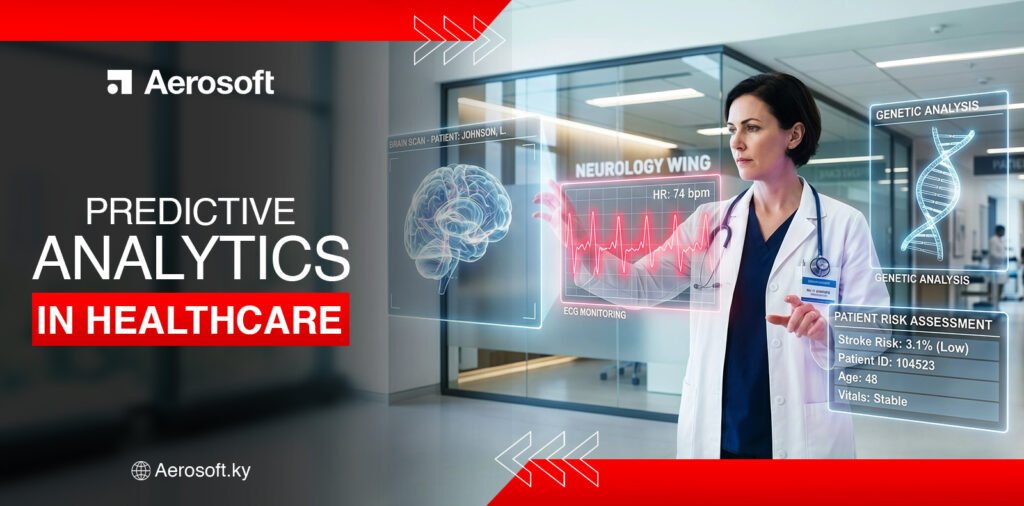
This is not a replacement story. It is an augmentation story, and it is the central narrative of AI’s role in clinical diagnosis in 2026. Across radiology, pathology, cardiology, ophthalmology, and primary care risk stratification, predictive analytics, and AI diagnostic tools are demonstrating clinical performance that, in specific task categories, matches or exceeds specialist physician performance. The implications for patient outcomes, healthcare costs, and the geographic distribution of diagnostic capability are profound.
Quick Answer:
Predictive analytics in healthcare uses machine learning models to analyze medical images, patient data streams, and clinical records to detect diseases earlier, predict adverse events, and support diagnostic decisions. In 2026, AI diagnostic systems achieve 87%+ sensitivity in validated clinical applications (diabetic retinopathy, pneumothorax, stroke detection, cancer grading), matching specialist physician performance in specific tasks. Three categories of clinical AI exist: image analysis AI (radiology, pathology, ophthalmology), risk stratification AI (sepsis prediction, readmission risk, deterioration alerts), and clinical decision support AI (drug interaction alerts, care pathway adherence). Implementation requires prospective validation in the deployment environment, EHR/PACS workflow integration, and FDA regulatory compliance.
Clinical Evidence: AI diagnostic models for diabetic retinopathy detection achieve 87% sensitivity and 90% specificity in validated clinical studies, performance that matches fellowship-trained retinal specialists. In resource-limited settings where specialist access is constrained, AI screening enables the detection of a blinding condition in populations that would otherwise have no access to specialist-level diagnosis.
The Diagnostic Gap That Predictive AI Addresses
The global diagnostic gap, the difference between the diagnostic services that population health demands and the diagnostic capacity that the healthcare system can deliver, is one of the defining structural challenges of modern healthcare.
There are approximately 44,000 radiologists practicing in the United States serving a population of 335 million. The imaging volume that radiologists must process has grown at an estimated 5–7% annually for a decade, driven by aging population demographics, expanding imaging indications, and declining imaging costs. The radiologist workforce has not grown at anything approaching that rate. The result is increasing per-radiologist workload, longer turnaround times, and documented associations between high-volume reading conditions and increased error rates.
This pattern repeats across specialty areas: pathologist shortages in developing countries, dermatologist access gaps in rural regions, cardiologist capacity constraints in emerging markets. The diagnostic gap is not primarily a quality problem; it is a capacity and distribution problem. AI diagnostic tools address both dimensions simultaneously: they multiply the effective diagnostic capacity of existing specialists, and they extend specialist-level diagnostic capability to geographic and economic settings where specialist access is limited or absent.
The Three Categories of Predictive Healthcare AI
Not all healthcare AI is diagnostic. Understanding the three distinct categories of predictive AI in healthcare is essential for evaluating specific technology investments:
- Image analysis AI: systems that process medical imaging, X-ray, CT, MRI, histopathology slides, retinal photographs, dermatology images, to identify findings, localize abnormalities, and generate diagnostic probability scores. This category currently has the strongest clinical validation evidence and the most regulatory approvals.
- Risk stratification AI: systems that process structured patient data, demographics, lab values, medication history, vital sign trends, social determinants of health, to identify patients at elevated risk for specific adverse events: hospital readmission, sepsis development, cardiovascular event, disease progression. These systems are used to prioritize care management resources and trigger early interventions.
- Clinical decision support AI: systems that provide real-time guidance to clinicians at the point of care, flagging potential drug interactions, suggesting diagnostic considerations based on clinical presentation, identifying deviations from evidence-based care pathways. These systems operate as a second-check layer that catches errors and surfaces considerations that may not be top-of-mind in high-volume clinical environments.
AI in Radiology: The Most Mature Clinical AI Category
Radiology AI has the longest development history, the largest body of clinical validation literature, and the most regulatory approvals of any clinical AI category. The first FDA-authorized AI radiology applications were cleared in 2016; by 2026, over 900 AI/ML-enabled medical devices have received FDA authorization, with radiology representing the largest category.
Chest X-Ray Analysis: Population-Scale Screening
Chest X-ray is the most commonly performed imaging study globally, with approximately 2 billion performed annually worldwide. AI models trained on chest X-ray datasets have demonstrated the ability to detect pneumonia, pulmonary edema, pleural effusion, pneumothorax, and multiple other findings with accuracy comparable to experienced radiologists.
The population-scale screening application is particularly significant. In settings where radiologist access is limited, such as rural hospitals, community health centers, and low-income countries, AI chest X-ray analysis enables findings to be flagged for priority human review, ensuring that time-critical diagnoses (pneumothorax, large pleural effusion) receive rapid attention even when radiologist availability is constrained.
Mammography AI: Improving Breast Cancer Detection
Breast cancer is the most commonly diagnosed cancer in women globally, and mammography screening is the primary detection tool. AI analysis of mammography images has demonstrated the ability to detect cancers that are missed in standard radiologist reads, particularly small, early-stage lesions that are less visually conspicuous.
In randomized controlled trial evidence, AI-assisted mammography reading maintains equivalent cancer detection rates to dual-reader programs (two radiologists reading independently) while reducing radiologist reading time significantly. For health systems managing high mammography screening volumes, this represents both a quality improvement and an operational efficiency gain.
CT Stroke Detection: The Time-Critical Use Case
Ischemic stroke is a time-critical emergency where treatment efficacy degrades significantly with delay. The clinical maxim ‘time is brain’ reflects the estimated 1.9 million neurons lost per minute of untreated large vessel occlusion. AI systems that automatically analyze CT and CT angiography images and generate immediate alerts for large vessel occlusion, before radiologist review, are among the most clinically validated and most widely adopted AI diagnostic applications.
These systems reduce the time from imaging to treatment decision by an average of 30–40% in deployed implementations, a reduction that translates directly into improved neurological outcomes for patients with large vessel occlusion stroke.
Clinical Impact: In facilities deploying AI stroke detection systems, door-to-needle time for tPA administration has been reduced by an average of 28 minutes. Given that each 15-minute reduction in treatment time is associated with approximately 1% absolute improvement in functional outcome, this represents a quantifiable patient benefit per deployment.
AI in Pathology: The Digital Tissue Revolution
Digital pathology, the digitization of glass tissue slides into high-resolution whole-slide images, creates the data substrate for AI pathology analysis. AI models trained on digitized pathology slides can identify cancer cells, grade tumor aggressiveness, detect specific molecular markers, and quantify tissue characteristics with a precision and consistency that exceeds human pathologist performance in specific task categories.
Cancer Grading and Prognosis
Tumor grading, the assessment of how aggressive a cancer appears under the microscope, is a critical determinant of treatment planning. AI pathology models demonstrate excellent agreement with expert pathologist grading for prostate cancer (Gleason grading), breast cancer (Nottingham grade), and colorectal cancer, with the additional capability to identify prognostic patterns in tissue morphology that are not part of standard grading systems but correlate with patient outcomes.
The clinical implication is significant: AI pathology analysis may identify patients at elevated risk for treatment failure or recurrence from tissue slides that appear standard under conventional grading, enabling more intensive treatment or monitoring for high-risk patients identified by AI that standard grading would classify as lower risk.
Rare Disease Detection at Scale
Rare diseases are, by definition, individually uncommon, but collectively represent a significant diagnostic burden. Pathologists examining high-volume slide libraries see rare disease presentations infrequently enough that recognition can be challenging. AI models trained on large repositories of rare disease pathology can maintain detection capability for rare presentations at consistent performance regardless of how infrequently they appear in the current slide volume, effectively solving the ‘out of sight, out of mind’ problem that contributes to delayed diagnosis of rare conditions.
Risk Stratification AI: Predicting Adverse Events Before They Occur
Predictive risk stratification, identifying patients likely to experience adverse events before those events occur, is the category of healthcare AI with the most direct impact on population health management and hospital operations.
Sepsis Prediction: The Most Studied Risk Stratification Use Case
Sepsis is a life-threatening condition that develops when the body’s response to infection causes organ damage. It kills approximately 270,000 Americans annually and accounts for 35% of all in-hospital deaths. Early identification of sepsis, before it progresses to septic shock, is the primary determinant of survival: each hour of delay in antibiotic administration increases mortality by an estimated 7%.
AI sepsis prediction models process continuous streams of vital sign data, laboratory results, medication orders, and nursing documentation to generate real-time sepsis risk scores for hospitalized patients. These models have demonstrated the ability to identify high-risk patients an average of 6–12 hours before clinical recognition, providing the window needed for early intervention that significantly alters survival probability.
Hospital Readmission Prevention
Unplanned hospital readmissions within 30 days of discharge represent a significant quality failure and a major cost driver in healthcare systems globally. The Centers for Medicare and Medicaid Services in the United States penalizes hospitals financially for excessive readmission rates for specified conditions, creating a direct financial incentive for readmission prevention programs.
AI readmission risk models analyze discharge data, diagnosis, procedure history, medication complexity, social determinants of health, and prior utilization patterns to generate risk scores that identify patients most likely to require readmission. High-risk patients are prioritized for discharge planning interventions: medication reconciliation, post-discharge follow-up calls, care coordination referrals, and community health worker outreach.
Validated AI readmission models have demonstrated 15–25% reductions in 30-day readmission rates in deployed implementations, with the greatest impact in patients with heart failure, pneumonia, and COPD, the conditions with the highest readmission penalties.
Precision Medicine: AI as the Foundation for Individualized Treatment
Precision medicine, the matching of treatment protocols to individual patient characteristics rather than population averages, has been a clinical aspiration for decades. AI makes it operationally viable by enabling the analysis of multi-dimensional patient data at a scale and complexity that human clinical reasoning alone cannot process.
Genomic data, proteomics, imaging biomarkers, electronic health record history, wearable device data, and social determinants of health, integrated through AI analytical platforms, create patient profiles with sufficient detail to identify treatment response patterns that population-level clinical trials cannot detect.
The oncology application is furthest developed: AI platforms that integrate tumor genomic sequencing data with a patient’s specific disease history, prior treatment response, and co-morbidity profile can identify treatment combinations associated with improved outcomes for patients with specific molecular profiles, going beyond the one-size-fits-all treatment protocols that clinical guidelines necessarily produce.
The Regulatory and Implementation Landscape for Clinical AI in 2026
Deploying AI diagnostic tools in clinical environments requires navigating a regulatory landscape that is evolving rapidly. In the United States, the FDA regulates AI/ML-enabled medical devices under its 510(k) and De Novo pathways, and has published guidance on continuous learning systems that update after deployment. The EU AI Act creates a risk-based regulatory framework that classifies clinical AI as high-risk, requiring conformity assessments and post-market monitoring.
Validation Requirements: Beyond Academic Performance
Clinical AI deployments require prospective validation in the specific clinical environment where the tool will be used, not just retrospective validation on the development dataset. A chest X-ray AI model validated on images from academic medical centers may perform differently in a community hospital setting where imaging technique, patient demographics, and disease prevalence differ from the development population.
AeroSoft Global’s clinical AI implementations include prospective validation protocols: shadow mode deployment for an initial period to measure performance in the actual deployment environment before the AI assumes decision support authority.
Workflow Integration: The Adoption Determinant
The most clinically validated AI diagnostic tool will fail to deliver population-level impact if it does not integrate cleanly into clinical workflows. AI that requires clinicians to log into a separate system, manually upload images, and navigate a new interface will be used inconsistently, or not at all. AI that delivers findings directly in the radiology workstation, the EHR, or the order management system, as a seamlessly integrated decision support element, achieves the workflow adoption that translates clinical validation into operational impact.
AeroSoft Global’s Clinical AI Implementation Approach
AeroSoft Global designs and deploys clinical AI systems with workflow integration as a first-class requirement, not an implementation afterthought. Our implementations connect directly to your PACS, EHR, and order management infrastructure through documented integration architectures that do not require disruption to existing clinical systems.
- Needs assessment: identifying the diagnostic bottlenecks, quality gaps, or capacity constraints that clinical AI can most effectively address in your specific environment
- Model selection and validation: identifying appropriate AI diagnostic models, conducting retrospective validation on your institutional data, and designing prospective validation protocols
- Integration architecture: designing the technical integration between AI diagnostic tools and your existing clinical systems (PACS, EHR, LIS)
- Phased deployment: implementing in shadow mode, validating performance, training clinical staff, and transitioning to active decision support authority
- Ongoing monitoring: continuous performance monitoring, regular accuracy auditing, and model updating as clinical evidence and technology evolve
Conclusion: AI Diagnosis Is Not the Future of Healthcare, It Is the Present
Predictive analytics and AI diagnostic tools are not experimental technologies approaching clinical deployment. They are validated, FDA-authorized, production-deployed clinical tools that are improving diagnostic accuracy, reducing care delays, enabling earlier disease detection, and extending specialist-level diagnostic capability to underserved populations today.
The health systems that are building durable quality and efficiency advantages in 2026 are those integrating AI diagnostic tools into clinical workflows as core operational infrastructure, not as innovation projects or pilot programs. The evidence base for clinical AI is now deep enough to justify operational deployment decisions, and the patient outcome implications of continued non-adoption are increasingly difficult to defend clinically or ethically.
AeroSoft Global helps healthcare organizations navigate from AI interest to clinical deployment, with the technical integration depth and regulatory compliance experience to make AI diagnostic tools work in your specific clinical environment. Contact our healthcare AI Automation team to discuss your diagnostic capability gaps and the AI solutions validated to address them.
Improve diagnostic accuracy, reduce care delays, and extend specialist capability to your full patient population. Contact AeroSoft Global for a clinical AI needs assessment and validated deployment roadmap.

