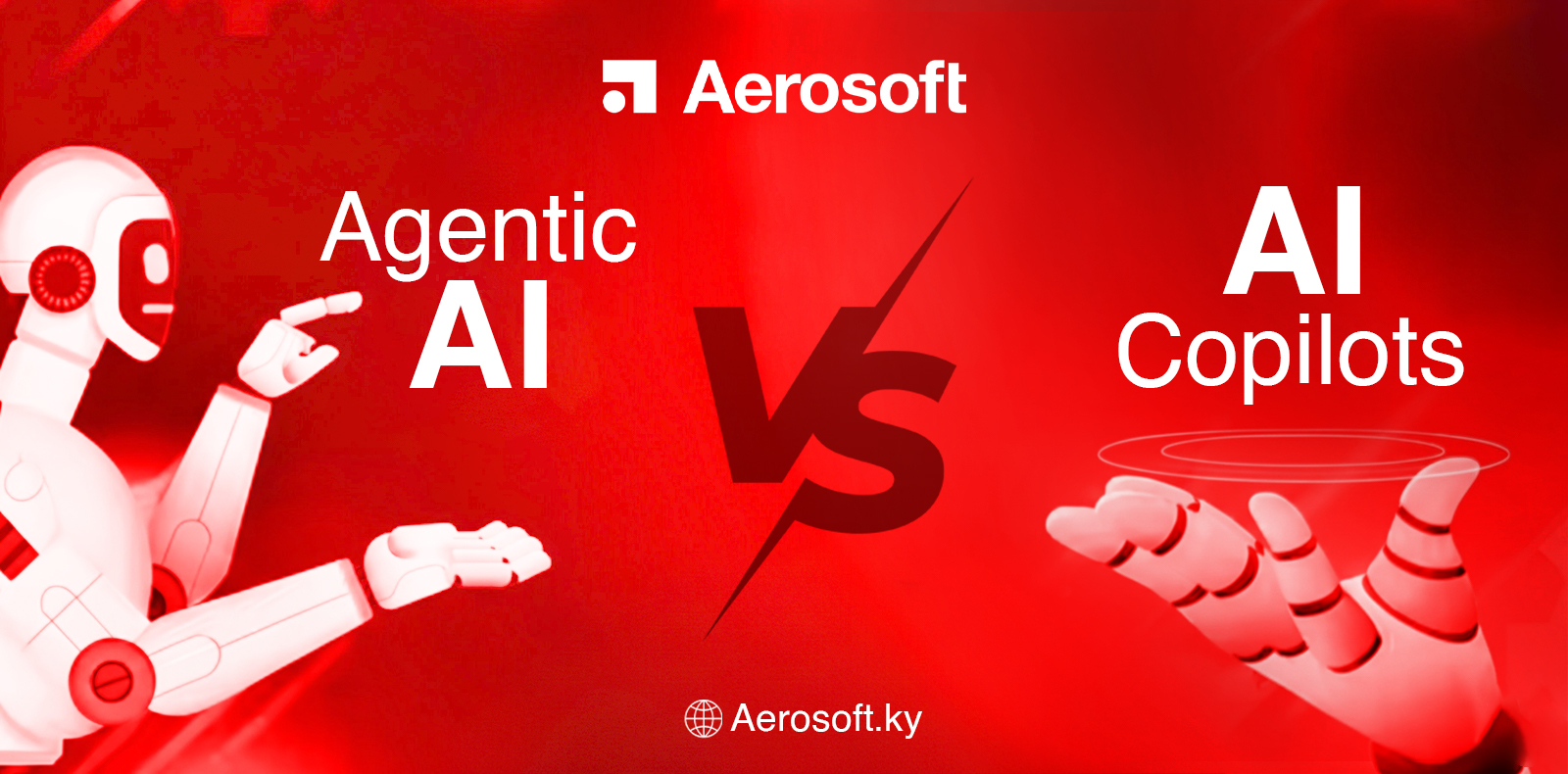
Agentic AI vs. Copilots: The Year of the Autonomous Operator
How agentic AI differs from copilots architecturally, and what it means for which workflows still need a person and which ones no longer do.
For the last two years, the headline AI story was the copilot, a brilliant assistant sitting beside a human, suggesting, drafting and answering. In 2026 the story changes. The breakout pattern is the agent: software that does not wait to be asked, but is given an objective and pursues it across multiple steps, tools and systems until the work is done.
This is not a marketing distinction. It is an architectural one, and it changes what AI is worth to a business. A copilot makes a person faster at a task. An agent removes the task. Understanding that gap, and where each pattern belongs, is the most important AI decision a business will make this year.
A copilot accelerates a human inside a workflow. An agent is given the outcome and owns the workflow. The first multiplies a person's output; the second changes how many workflows need a person at all.
What a Copilot Actually Is
A copilot is a reactive, in-context assistant. It lives inside a tool you are already using, a document, an inbox, a code editor, a CRM record, and it responds to a prompt with a suggestion. The human stays in the driver's seat for every step: they ask, they read, they accept or reject, they move to the next step and ask again.
This is genuinely valuable. Copilots compress the time between intention and first draft, lower the cost of starting, and make specialised knowledge available on demand. But the copilot has a structural ceiling: it can only ever be as productive as the human operating it, because the human is the loop. Every cycle still passes through a person's attention. The copilot makes the loop faster; it does not remove the loop.
What an Agent Actually Is
An agent is given an objective rather than a prompt. "Resolve this support ticket." "Reconcile this week's invoices against the bank feed." "Qualify these inbound leads and book the meetings." It then plans the steps, calls the tools and systems it needs, evaluates what comes back, adjusts course when something does not fit, and continues until the objective is met or it hits a boundary that requires a human.
Four capabilities separate an agent from a copilot:
- Planning, it decomposes a goal into a sequence of steps rather than executing a single instruction.
- Tool use, it can call APIs, query databases, send messages and operate other software to act in the world, not just produce text.
- Memory, it carries state across steps and sessions, so progress, context and prior decisions persist.
- Self-correction, it checks its own results against the objective and retries or re-plans when something is wrong.
Those four capabilities turn AI from a thing you operate into a thing that operates. That is why 2026 is being called the year of the autonomous operator.
Why the Shift Is Happening Now
Agents are not a new idea, the idea is older than the current model generation. What changed is that three enabling pieces matured at the same time. Models became reliable enough at multi-step reasoning to plan without losing the thread. Tool-use and function-calling interfaces became standardised, so an agent can act on real systems predictably. And orchestration frameworks made it practical to give an agent guardrails, memory and oversight rather than hoping it behaves. The capability did not appear overnight; the surrounding scaffolding finally caught up to it.
Where Each Pattern Belongs
The mistake to avoid is treating this as a contest with a single winner. Copilots and agents solve different problems, and a mature AI strategy uses both.
Use a Copilot When Judgement Is the Point
For creative direction, strategic analysis, sensitive communication and any task where a human must own the outcome, the copilot is the right pattern. Here you want acceleration, not autonomy, the human's judgement is the value, and the AI's job is to make exercising it faster.
Use an Agent When the Workflow Is the Cost
For high-volume, rule-bounded, multi-step processes, ticket triage and resolution, data reconciliation, lead qualification, document processing, routine reporting, the workflow itself is the cost, and the agent is the right pattern. These processes have clear objectives, definable success criteria and a stable set of tools, which is exactly the environment an agent thrives in.
A useful test: if the value is in how well the task is done by a person, reach for a copilot. If the value is simply in the task being done, reliably, at volume, reach for an agent.
Deploying Agents Responsibly
Autonomy raises the stakes. An agent that acts on real systems can create real consequences, so the engineering around it matters as much as the model inside it.
Bounded Authority
An agent should have exactly the permissions its objective requires and no more. It reads what it needs, writes only where it must, and high-consequence actions, issuing a refund above a threshold, sending an external commitment, deleting records, sit behind a human approval step by design.
Observability
Every plan, tool call and decision an agent makes should be logged and inspectable. When something goes wrong, the team must be able to see precisely what the agent did and why. An agent you cannot audit is an agent you cannot trust in production.
Graceful Escalation
A well-built agent knows the edge of its competence. When it encounters ambiguity, low confidence or a situation outside its remit, it should hand off to a human cleanly, with full context, rather than guessing. Escalation is not failure; it is the feature that makes autonomy safe.
What This Means for Your Business
The firms that win with AI in 2026 will not be the ones that simply bought the most copilots. They will be the ones that looked honestly at their operations, separated the workflows where human judgement is the product from the workflows where the process is just a cost, and deployed the right pattern to each.
Aerosoft builds both, copilots that make your people faster, and agents that take routine operations off their plate entirely, with the guardrails, observability and escalation paths that make autonomous software safe to run. The autonomous operator is here. The question is no longer whether to use it, but where.
Ready to put an agent on the routine work?
We'll review your operations, identify the workflows ready for autonomy, and design the agents and guardrails that make it safe to run.
Talk to Our TeamFREQUENTLY ASKED QUESTIONS
Agentic AI, answered.
A copilot is a reactive assistant that responds to prompts inside a tool a human is using, the human runs the loop. An agent is given an objective and autonomously plans the steps, uses tools and systems to act, and completes a multi-step workflow until the goal is met.
Four capabilities: planning a goal into steps, using tools and systems to act in the world, retaining memory across steps and sessions, and self-correcting when results don't match the objective. Together these turn AI from a tool you operate into a system that operates on your behalf.
Both. Use copilots where human judgement is the value, strategy, creative work, sensitive communication. Use agents where the workflow itself is the cost, ticket resolution, data reconciliation, lead qualification, document processing. A mature AI strategy uses both patterns.
Yes, when engineered correctly, with bounded permissions (the agent has only the access it needs), human approval steps for high-consequence actions, full observability (every decision is logged), and graceful escalation (the agent hands off cleanly when it hits the edge of its competence).
Because three enabling pieces matured together: models reliable enough for multi-step reasoning, standardised tool-use interfaces that let agents act on real systems, and orchestration frameworks that provide the guardrails, memory and oversight that make autonomy safe to deploy in production.
Put an agent
on the routine work.
We'll review your operations, identify the workflows ready for autonomy, and design the agents and guardrails that make it safe to run.
Talk to our experts