

01.
Process discovery
We document how the process really runs , every step, hand-off and exception.
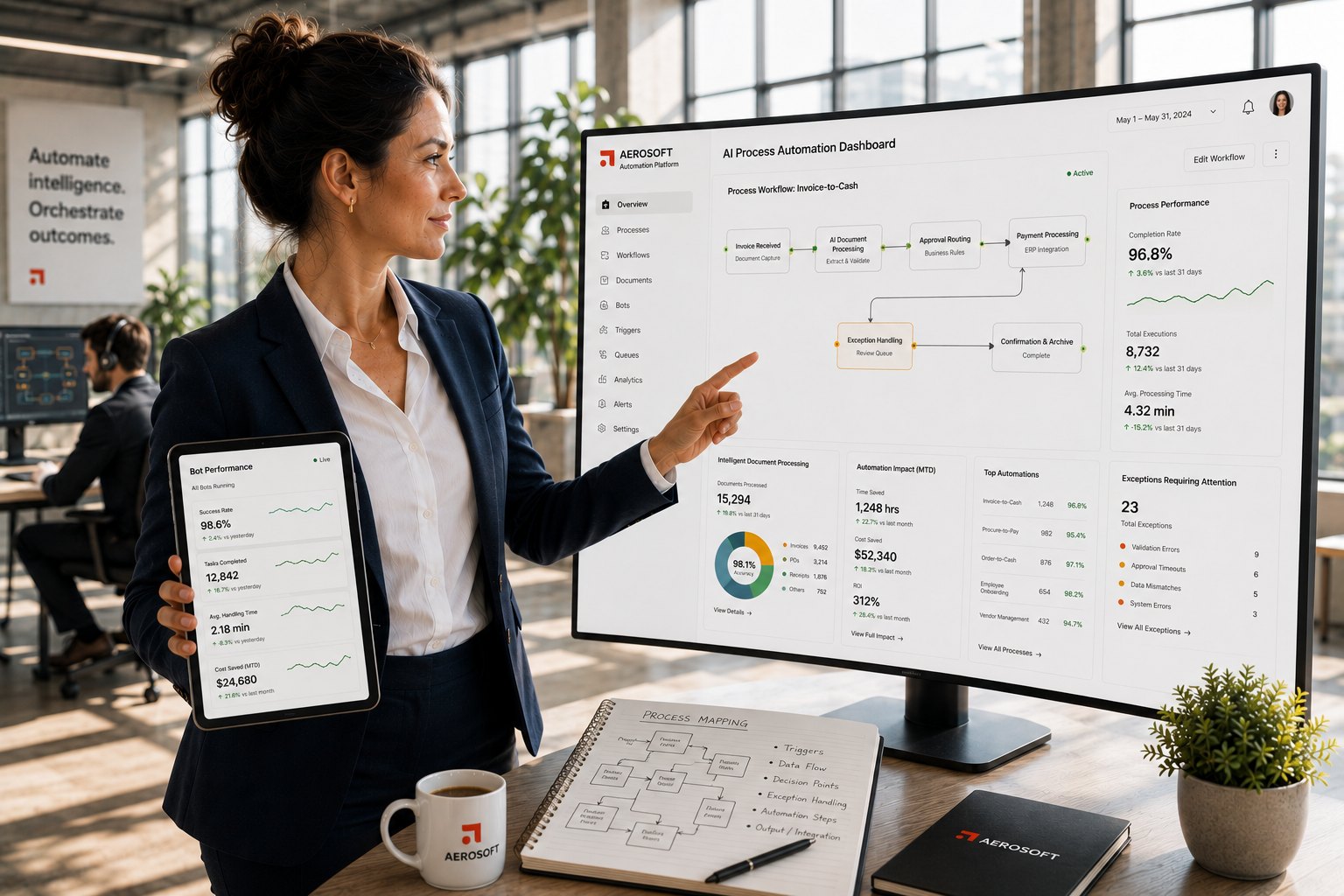
Automating a process is easy to show and hard to sustain. The demo runs on tidy inputs. Production does not , it brings messy data, fragmented systems, unclear ownership and a process that quietly changes the moment the automation is finished.
That is why so much automation is abandoned. It was built as a script, not a system , no integration depth, no audit trail, no way to adapt when reality moves. The first awkward exception breaks it, and the manual work returns.
Aerosoft builds business process automation to survive production. It executes inside your real constraints , security, approvals, auditability, SLAs and change control , across the ERPs, CRMs, ticketing and document-heavy queues your operation actually runs on.
The outcome is shorter cycle times, traceable events for genuine operational visibility, and automation that scales safely because governance, rollback and monitoring were built in from the first day , not added after something broke.
Automating one task in isolation just moves the bottleneck. We automate the whole process , the hand-offs, the decisions and the exceptions , so it runs end to end.

We document how the process really runs , every step, hand-off and exception.

We map the future-state process and where AI or rules should take over.

We design the orchestration, decision points and human checkpoints.

We build the automation and connect every system the process touches.
We run it alongside the current process until results are proven and trusted.

We launch, monitor SLAs and refine the process as the business changes.
Most processes on paper bear only a passing resemblance to how the work really happens. We document how a process actually runs , the workarounds, the waiting, the rework , not the tidy version in the manual. That honest picture surfaces the delays and risk hiding inside, which is where automation pays off.
Every business runs on repetitive steps a person should never have been doing by hand. We automate the deterministic, rule-based work reliably , data moved, records updated, documents generated. The routine simply happens, correctly, without consuming anyone’s attention or time.
Plain rule-based automation breaks the moment a process needs judgement. AI handles those steps , classification, exception handling, routing , that simple rules cannot, while humans review the calls that genuinely matter. The whole process flows, not just the easy three-quarters of it.
Most delay does not live inside the steps , it lives in the gaps between them, at every hand-off. We connect people, systems and steps into one orchestrated flow. The whole process runs through end to end, instead of stalling each time it passes from one team or tool to the next.
An SLA nobody is actively watching is an SLA that gets missed. The system tracks timing against your service levels continuously and escalates before a deadline is breached, not after. SLAs stop being a hopeful target and become something the process itself actively protects.
A process you cannot see is a process you cannot improve. You get dashboards on throughput, bottlenecks and exceptions , a live view of how the work is really flowing. Problems show up early, and each round of improvement is grounded in evidence rather than hunches.
We start with one workflow, one measurable KPI and a bounded integration surface. You get a clear automation boundary, exception paths and a delivery plan tied to throughput, cost per transaction or cycle time. If it can’t be measured or owned post-launch, it stays out of scope.
It is built around risk control: workflow mapping including exceptions, integration design, guardrails and auditability, build and validation on real samples, then a production rollout with monitoring and runbooks , so your team can maintain what ships.
The first wave reduces operational load quickly: lower manual triage, fewer handoffs, faster routing and validation. The second wave reduces exception volume and stabilises quality , the strongest gains show up when exceptions are engineered down rather than absorbed by staff.
You do. Every workflow ships with documentation, runbooks and monitoring your team can operate, and you hold the source and configuration outright , there is no per-process licence and no vendor lock-in.
Judgement steps run with defined confidence thresholds and approval gates. Low-risk decisions execute automatically; anything ambiguous or high-impact is routed to a person, with a full audit trail of what the system did and why.
Tell us about the process costing you the most time. We’ll map the automation we’d build and what it would return.
Request a quote