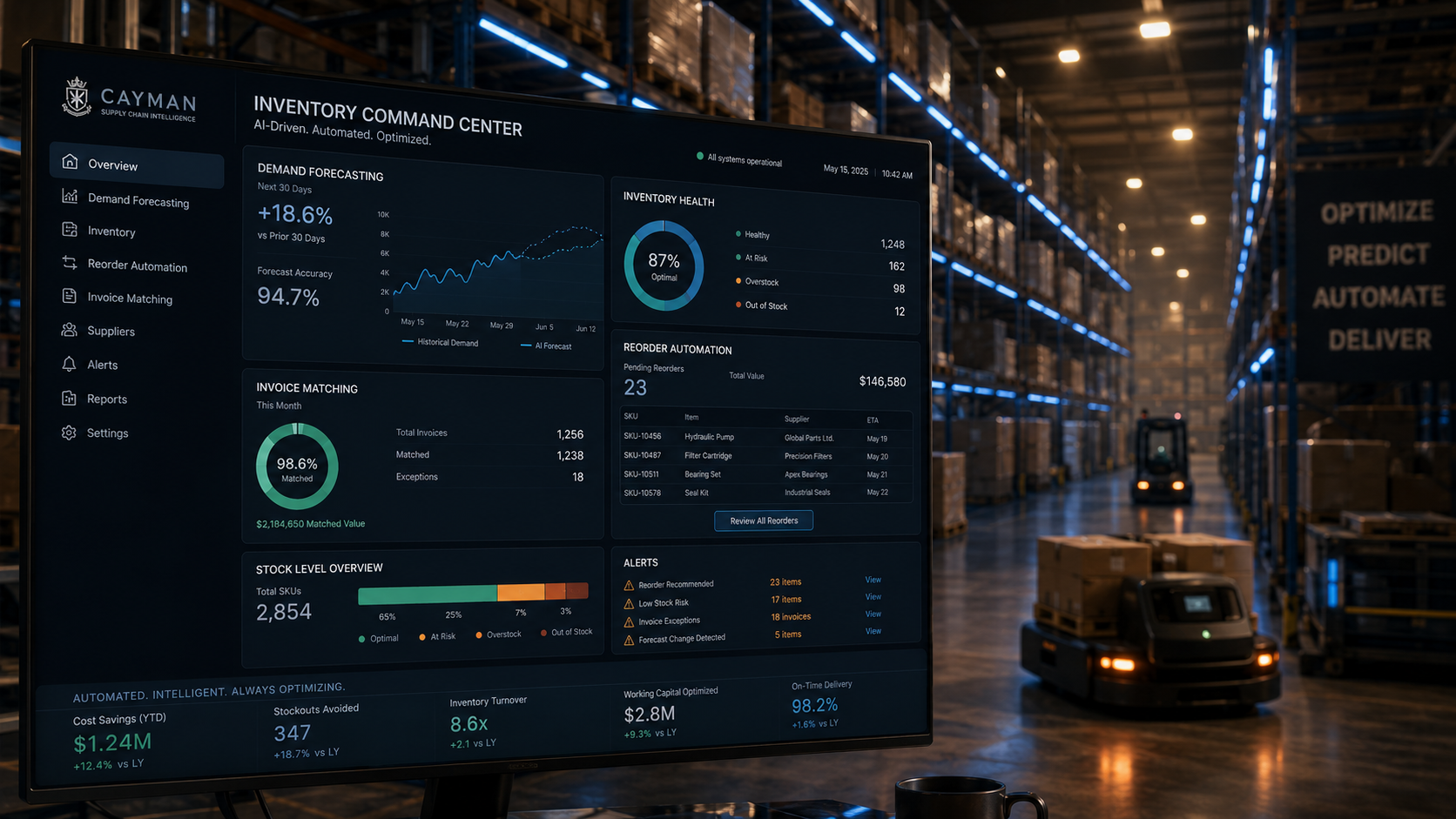
The Seeing Warehouse: Computer Vision & the Logistics Labour Crisis
How computer vision and autonomous mobile robots are converting a structural labour shortage into a permanent operational advantage for distribution centres.
Walk into almost any distribution centre in 2026 and you will hear the same problem described in different words: not enough people, and the people there are doing work no one wants to do for long. The logistics labour crisis is not a temporary squeeze. It is a structural shift, and the warehouses adapting fastest are the ones learning to see.
The "seeing warehouse" is a facility where computer vision is woven through the operation: cameras and sensors that do not just record but interpret, reading labels, counting stock, spotting damage, guiding robots and catching errors before they ship. It is the practical answer to a labour shortage that hiring alone can no longer solve.
The seeing warehouse does not replace the workforce. It removes the repetitive, error-prone, physically punishing tasks that the workforce was never the right tool for, and redeploys people to the judgement, exception-handling and oversight roles that machines are not.
The Crisis Is Structural, Not Cyclical
Warehouse and fulfilment roles have become persistently hard to fill and harder to retain. Three forces compound. Demand keeps rising: e-commerce has permanently raised order volumes and shrunk delivery-time expectations. The work is demanding: long shifts, repetitive motion and physical strain produce turnover rates far above most industries. And the labour pool is tightening: demographics and competition from other sectors mean the supply of people willing to do this work is shrinking even as demand for it grows.
An operation cannot hire its way out of that. The gap between the labour a modern fulfilment operation needs and the labour available is now wide enough that the only durable response is to change how much human labour each order requires. Computer vision is the most effective lever for doing that.
What Computer Vision Actually Does on the Floor
Computer vision is the discipline of teaching software to extract meaning from images and video. In a warehouse, that capability translates into a set of concrete, high-value jobs.
Receiving and Put-Away
Vision systems read labels, barcodes and packaging at the dock, verify what arrived against what was ordered, flag damage on arrival, and capture dimensions and weight automatically. The slowest, most error-prone moment in the inbound process, manual checking, becomes instant and consistent.
Inventory and Cycle Counting
Cameras, fixed, on robots or on drones, count and locate stock continuously rather than during disruptive periodic audits. Inventory accuracy stops being a number that decays between counts and becomes a live figure the whole operation can trust.
Picking Accuracy
Vision verifies that the item picked matches the item ordered at the moment of picking. A mispick caught at the shelf costs seconds; the same mispick caught by a customer costs a return, a re-ship, a support contact and trust.
Quality and Damage Detection
Vision models trained on a product set identify damage, defects and packaging faults far more consistently than a tired human eye at the end of a shift, and they never stop paying attention.
Robot Guidance and Safety
Autonomous mobile robots depend on vision to navigate, locate stock, avoid obstacles and work safely alongside people. Vision is the sense that makes warehouse robotics possible at all.
Vision and Robots: A Single System
The seeing warehouse reaches its full value when computer vision and autonomous mobile robots operate as one system rather than two projects. Robots provide the movement, transporting goods, carrying shelves to pickers, moving pallets, while vision provides the perception that lets them do it safely and intelligently. A robot without vision is a slow, fragile, heavily constrained machine. Vision without robots improves visibility but still leaves the physical work to people. Together they form a flexible automation layer that scales with order volume instead of with headcount.
The ROI concentrates in five places: labour productivity (each remaining worker handles more throughput), error reduction (fewer returns and re-ships), inventory accuracy (reduced working capital), throughput speed (faster delivery promises), and safety (fewer injuries and insurance exposure). The strongest business cases combine modest gains across all five.
How to Deploy Without Betting the Operation
The failure mode in warehouse automation is the big-bang project, trying to transform the whole facility at once. The disciplined path is incremental.
Step 1, Instrument and measure. Before automating anything, get accurate data on where time, errors and cost actually concentrate. The bottleneck is rarely where intuition says it is.
Step 2, Pilot one high-pain process. Choose a single workflow, inbound checking, cycle counting, pick verification, and prove the value in a contained, measurable deployment.
Step 3, Integrate, do not bolt on. Vision systems must talk to the warehouse management system so insight becomes action; a vision system that only produces a separate dashboard has not finished the job.
Step 4, Expand on evidence. Scale to the next process once the pilot has delivered measured results, building the seeing warehouse one proven step at a time.
Aerosoft's Approach to Warehouse Computer Vision
Aerosoft builds warehouse computer vision and integration layer with the disciplined approach: instrumented, piloted and expanded on evidence. Every deployment begins with a workflow analysis that maps where errors, delays and costs concentrate, identifies the two or three processes where vision delivers the clearest measurable return, and sizes the integration requirements against the existing WMS.
The vision system is always built to feed the WMS in real time, not as a parallel dashboard, but as the data source the operation runs on. This means inventory positions, inbound discrepancies and quality flags are visible to the people who need to act on them, within seconds of the event.
Seeing Is Operating
The logistics labour crisis is not going to resolve itself, and the warehouses that keep treating it as a hiring problem will keep falling behind. The ones that treat it as a perception problem, that give the facility the ability to see, count, check and guide, convert a structural shortage into a structural advantage.
Aerosoft builds the computer-vision systems and the integration layer that make a warehouse see, and we build them the disciplined way: instrumented, piloted and expanded on evidence. The seeing warehouse is not a futuristic vision. It is the current edition of a well-run operation.
Ready to give your warehouse the ability to see?
Talk to our computer vision team about a workflow analysis and deployment roadmap for your distribution centre.
Talk to Our TeamFREQUENTLY ASKED QUESTIONS
Warehouse computer vision, answered.
Computer vision systems read labels and barcodes, verify inbound deliveries, count inventory continuously, confirm picks are correct, detect product damage, and guide autonomous mobile robots, replacing the manual checking and counting tasks that consume warehouse labour and generate errors.
Computer vision removes repetitive, physically demanding tasks, reading labels, counting stock, checking picks, not the workforce. People are redeployed to supervision, exception-handling and the judgement calls that machines cannot make. Most deployments reduce the number of people needed per order, which addresses the labour shortage rather than creating redundancy.
Returns concentrate in labour productivity, error reduction (fewer returns and re-ships), inventory accuracy (less buffer stock), throughput speed and safety. Well-scoped deployments that address high-pain processes typically achieve payback in 3-18 months, combining gains across all five areas.
Autonomous mobile robots provide movement, transporting goods, carrying shelves, moving pallets, while computer vision provides the perception that makes safe, intelligent navigation possible. Together they form a flexible automation layer that scales with order volume rather than headcount.
Start by instrumenting and measuring, understanding where errors, delays and costs actually concentrate. Then pilot one high-pain process, prove the return in a contained deployment, integrate the system with your WMS, and expand on evidence. Avoid large-scale transformations before a pilot has validated the approach in your specific environment.
Give your warehouse
the ability to see.
Aerosoft builds computer vision systems and WMS integration that turn perception into operational advantage, instrumented, piloted and expanded on evidence.
Talk to our experts