
Government Software Development in the Cayman Islands
Civic platforms that actually work for citizens.
Let’s talkAerosoft builds software for Cayman Islands government bodies, authorities and statutory agencies. Permitting and licensing, public-facing service portals, case management, and the accessibility and record-keeping standards public work demands.
- Permitting, licensing and application portals
- Case management and internal workflow
- Accessible public service interfaces
- Records, audit trail and reporting
Public sector technology has to be secure, accessible, and dependable for decades. Aerosoft builds for all three, and hands over the source code in writing.
Ask anyone who runs a government department, authority or statutory body in the Cayman Islands where the week goes, and the answer is rarely the mandate itself. It goes to paper forms that arrive incomplete, applications sitting in a tray waiting for a signature, residents calling three numbers to reach the right officer, and the same name and address typed into four systems that do not talk to each other. The public service is the point. The manual handling around it is what slows everything down.
Off-the-shelf government platforms rarely fit, because they were built for another country’s departments, another country’s forms and another country’s law. The result is a system that technically runs while a clerk still re-keys every application by hand and a resident still drives into George Town to drop off a document they could have uploaded. Public money pays for the licence and the workaround both.
Aerosoft builds public-sector software the other way round. We start with the service a resident is actually trying to use, a permit, a licence renewal, a payment, a records request, and we shape the system around that journey and the officers who process it. The measure is simple: fewer counter visits, faster turnaround on applications, a clean audit trail on every decision, and reporting a chief officer can trust on a Monday morning.
What we hear most from public sector teams.
Citizens unable to reach the right department
Phone queues and misdirected calls leaving residents frustrated with essential services.
Accessibility to services is a fundamental expectation. AI-assisted routing and online self-service portals get citizens to the right help, quickly.
See how we solve itPaper-based processes slowing services
Applications and approvals moving by post and physical signature, adding weeks to citizen outcomes.
Digital-first government delivers faster, fairer outcomes. Secure e-forms and automated routing process applications in days, not weeks.
See how we solve itInterdepartmental data that never aligns
Each department maintaining separate records, leading to inconsistencies and poor citizen experiences.
Connected systems serve citizens better. A unified platform ensures every public servant works from a single source of truth.
See how we solve itSystems for every part of public service.
Citizen service portals
One secure account where a resident, business owner or work-permit holder signs in once and does their government business in a single place. They check the status of an application, renew a licence, pay a fee, upload a document and get a reply, without driving into George Town or sitting in a phone queue. Every service a resident completes themselves is a transaction your counter staff do not process by hand, and the details arrive structured and ready for an officer to action.
Online forms, permits & applications
The paper forms a department runs on, trade and business licences, planning and building permits, event approvals, vehicle and driver records, rebuilt as guided online forms that validate as they are filled. Required fields, supporting documents and fees are captured up front, so an application lands complete instead of bouncing back for a missing page or signature. Each submission routes automatically to the right officer with a clear queue, a timestamp and a status the applicant can follow.
Online payments & fee collection
Government runs on fees, and collecting them should not mean a cheque and a trip to a cashier. We build online payment into the same workflow as the application, so a permit or licence-renewal fee is paid by card at the point of submission, in KYD or USD, with an automatic receipt and clean reconciliation for finance. Takings are logged against the right account and department in real time, so the month-end report writes itself instead of being pieced together from a stack of receipts.
Case management & internal workflow
Behind every public service is a queue of cases that have to move. We build the internal side: assignment to officers, review and approval steps, escalation when something sits too long, and a full history of who did what and when. Supervisors see where each case stands and where the bottleneck is, rather than asking around or reconstructing a timeline after a resident complains.
Document management & records
Government generates records that have to be found years later, for an audit, a court matter or a Freedom of Information request. We build document management that stores files against the resident, business or case they belong to, with version history, access control and retention rules matched to how long each record must legally be kept. Officers search and retrieve in seconds instead of walking to a registry, and nothing of record sits unindexed on one person’s desktop.
Reporting & oversight dashboards
The numbers a ministry, board or chief officer needs should be a by-product of the work, not a quarterly scramble. We build dashboards that show application volumes, turnaround times, revenue collected, backlog and service levels by department, drawn live from the system. When a budget submission, a Cabinet paper or an oversight committee asks a question, the answer is already on screen and traceable to the records behind it.
Public software is held to a higher standard, by law and by the public.
A glitch in a retail app annoys a customer. A dropped record or an inaccessible form in a government service can deny someone a licence, a payment or a right they are entitled to. That difference shapes everything we build for the public sector.
- 01Accessible to every resident. Public services have to work for older people, people with disabilities and someone on an old phone with a weak signal on Cayman Brac. We build to recognised web accessibility standards, with screen-reader support, keyboard navigation, strong contrast and plain language, so no one is shut out of a service they are entitled to.
- 02Security and privacy by design. Government holds identity documents, financial details and personal records. Access is role-based, data is encrypted in transit and at rest, every record change is logged, and we build with the Cayman Islands Data Protection Act in mind from the first line of code, not patched in before launch.
- 03Dependable for the long term. A department runs on the system every working day, and through hurricane season. We build for uptime, safe failure and tested recovery, with hosting and backups that hold up when the weather does not.
- 04Owned by you, outright. The source code, the data and the documentation are yours, transferred in writing. No per-seat licence that grows with every new officer, and no vendor holding a public service hostage. Any qualified developer can maintain what we hand over.
What changes when the software finally fits.
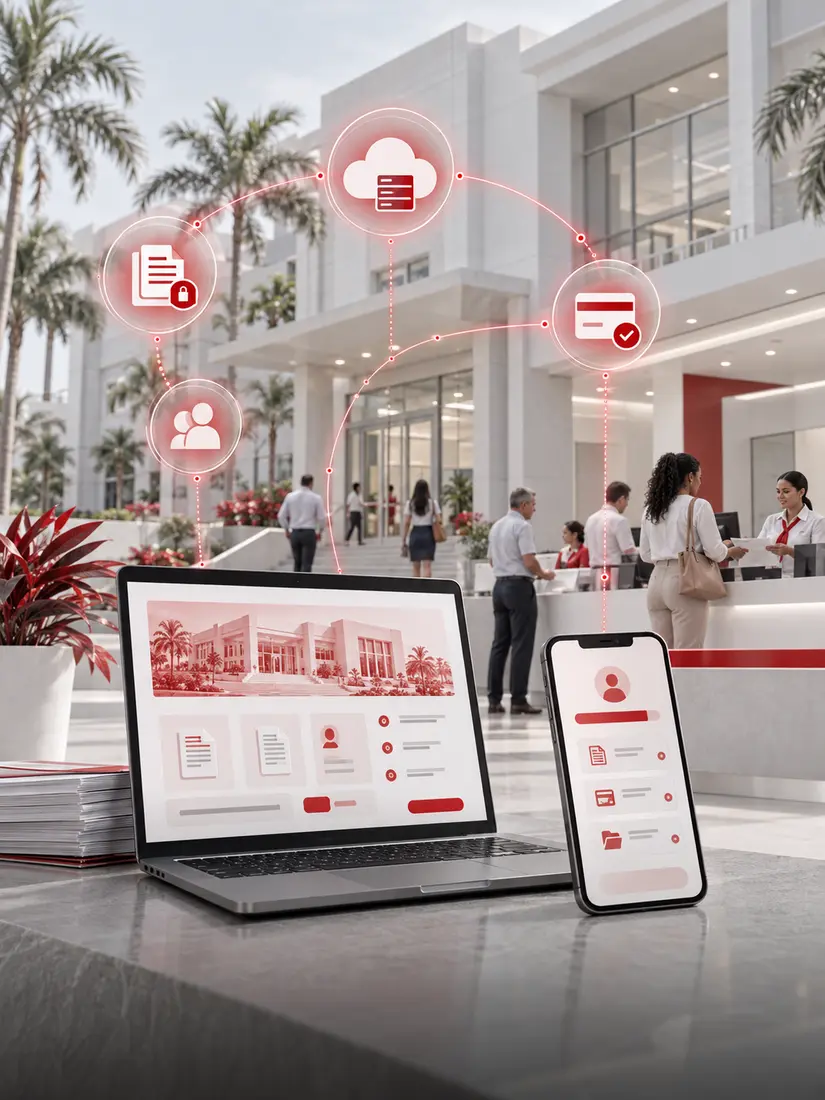
When a public-sector system is built around the service rather than imposed on the department, the change shows up at the counter and in the back office at the same time. Residents stop queuing for things they could do online, because the form, the payment and the document upload are in one place and actually work on a phone. Officers stop re-keying and chasing, because applications arrive complete and route themselves to the right desk.
It also changes what leadership can see. Disconnected spreadsheets and paper trays hide the things that matter, which services run slow and why, where applications pile up, how much revenue a department really collects, where a process quietly fails residents. A connected system surfaces all of it, turning a year of guesswork into a dashboard a chief officer can act on and defend.
And it changes what the next project costs. Adding a new permit type, opening a service to another island, connecting to another department or meeting a new reporting duty stops being a procurement from scratch. The system was built to extend, documented so any qualified developer can maintain it, and owned by the government outright, so public money buys an asset instead of renting someone else’s.
The services behind a government build.
A public-sector system is rarely one thing, it usually draws on a few of our core services working together. Here is where most departments and authorities begin.
Software Development
The case management, permitting and payments engine, custom software shaped around your department’s real workflow and Cayman’s own forms, not a template built for another country’s government.
Web Development
The citizen-facing portal and website, secure sign-in, online forms, document upload and payments, accessible and fast on whatever device a resident actually owns.
AI Automation
The repetitive handling taken off officers, routing applications, acknowledging submissions, flagging cases that have sat too long and answering the common questions, so staff spend their time on the decisions that need a person.
What Cayman public sector teams ask us.
How do you keep government and citizen data secure?
Citizen and departmental data is treated as the highest-sensitivity information in the system. Access is role-based so an officer sees only what their role requires, data is encrypted in transit and at rest, every record change is logged in an audit trail, and retention is configured to match how long each type of record must be kept. We build with the Cayman Islands Data Protection Act in mind and review security before launch, not after an incident.
Can a new system work with the software a department already uses?
Yes. We integrate with existing finance systems, payment processors, registries and record systems through secure, verified connections, so a new portal or workflow fits alongside what already works instead of forcing a full rip-and-replace. Where a legacy system has to stay, we build around it and bridge the data rather than demanding everything change at once.
How do you make sure a service is accessible to every resident?
We build to recognised web accessibility standards, with screen-reader support, keyboard navigation, strong colour contrast and plain-language forms, and we test on real devices and slower connections. A public service has to be usable by an older resident on an old phone and by someone using assistive technology, not only by a tester on a fast office computer.
Will residents still be able to get help in person?
Yes. Online services are there to shorten the queue, not replace the counter. The same system a resident uses online is the one your front-desk officer uses to help someone in person or over the phone, so there is a single record of the application whichever way it arrives. Digital-first does not mean digital-only, which matters for residents without easy internet access.
How long does a government software project take in the Cayman Islands?
A focused service, a single permit or licence moved online with payment and a status page, typically runs eight to fourteen weeks. A larger platform spanning several departments, with case management, document storage and reporting, takes longer and is delivered in defined phases. You see and test working software at each milestone, and we run the new system alongside the old process before any full cutover.
What happens after the system goes live?
Public systems cannot be left unmanaged. We provide support plans covering security patching, hosting and backups, monitoring, and changes as forms, fees or reporting duties change. You own the source code and documentation outright, so you are never locked in, and we stay on as a long-term partner because the work earns it, not because there is no alternative.
Take the queue off
the counter.
Tell us which service still runs on paper and a phone queue. We’ll show you the public-sector system we’d build to put it online, securely and for good.
Request a quote